


How We Operate
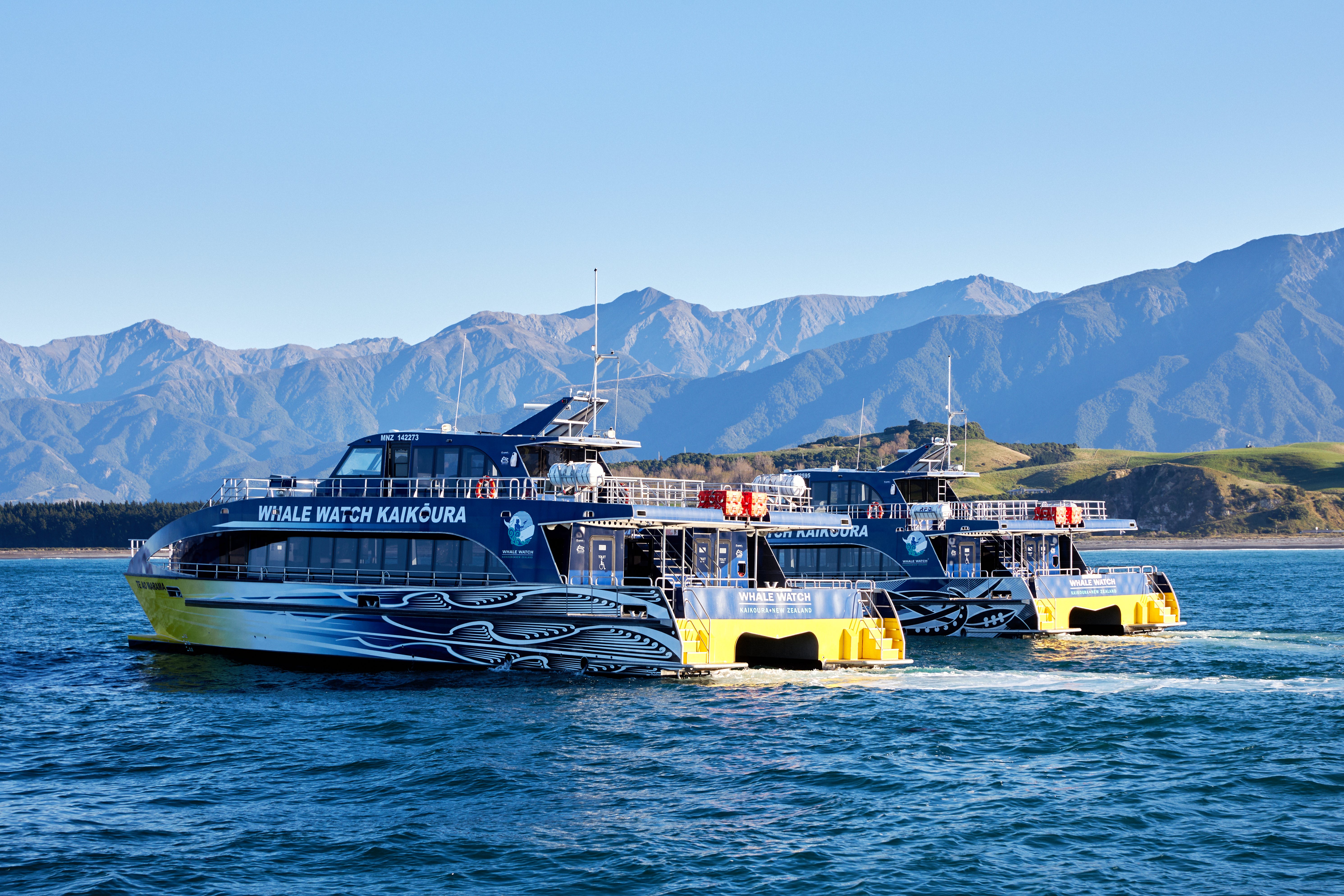
Our vessels are designed and built specifically for whale watching here in Kaikoura, our modern catamarans are equipped with engines that minimize underwater noise, no exposed propeller blades and toilets that never pollute the sea.
Scania DI16 076M Marine Diesel Engines each rated @ 662KW (900hp) are used on our vessels, these engines meet IMO Tier II emission standards as required for our type of operation here in New Zealand.
Hamilton jet units are used for our vessel propulsion, this system is quieter for the marine mammals compared to other traditional forms of vessel propulsion, they also have an internal propeller so the risk of a propeller blade strike with any marine mammal is eliminated.
The passenger cabins are fully enclosed, and large outside decks providing all surround viewing offering great viewing and photo opportunities.
Spacious air-conditioned interiors are fitted with comfortable seating while large screens display our award-winning marine wildlife animations.
A full tour narration is provided to keep our customers fully informed on the tour plan, the local environment, history of the area and the various species of marine wildlife that can be encountered off the Kaikoura coastline.
Passenger numbers are kept well below the maximum carrying capacity the vessel could cater for.
We meet all New Zealand regulatory rules and requirements for our type of operation and hold a current Marine Mammal Permit for commercial marine mammal watching from the New Zealand Department of Conservation.
Our Tour Times:
All year: 7.45am, 10.30am, 13.15pm & 16.00pm (November-March)
Tour scheduling is always subject to customer demand.
PLEASE TAKE NOTE:
The time provided when booking online is the departure time, please arrive 30 minutes prior for check-in. Departure times are NOT flexible; check-in will close promptly 5 minutes prior to the departure time.
Please arrive at our office 30 minutes earlier than your departure time to ensure a seamless check-in.
We have two cabin classes to select from.


How does the tour start?
- Check-in for all our tours takes place at our main office located at The Whaleway Station, Whaleway Station Road, Kaikoura.
- We are the only building on this road and have a large carpark available for customers during the day.
- Please note, you must check-in for your tour 30 minutes prior to the departure time.
- Once check-in procedures are completed and your ticket has been issued (30min is allowed for this process) you are then boarded onto a bus or van (depending on what cabin you are booked in) and transferred to the South Bay Marina where our vessels are berthed.
- The marina is located on the opposite side of the Kaikoura peninsula, this is a 6-7 min drive.
- Once at the marina you will be boarded onto your designated vessel.
- Once boarding procedures have been completed your vessel will depart.
About your tour?
Whale Watch is New Zealand's only vessel-based whale watching company offering an exciting up-close encounter with the world's largest toothed predator the Giant Sperm Whale in their natural environment at all times of the year, our +90% success rate means we guarantee an 80% refund if your tour does not see a whale.
For the avoidance of doubt, a whale, as defined by the Marine Mammals Protection Regulations 1992, means all species commonly known as whales; and includes baleen whales, sperm whales, beaked whales, killer whales and pilot whales.
The main focus of your tour is to locate and view a whale. We average between 1 to 2 whale sightings per tour due to the length of time some whales can stay submerged. The whales form loose pods, keeping several miles between each other, so viewing any more than 1 to 2 whales per trip is a real bonus.
Around 80% of the world’s whale and dolphin species migrate past our coastline so at any given time there is the opportunity for other species of marine mammals to be sighted such as Blue, Fin, Sei, Humpback, Minke, Pilot, Orca and Southern Right Whales, Common Dolphins, Bottlenose Dolphins, Southern Right Whale Dolphins, Elephant Seals and Leopard Seals.
Depending on the amount of time available after viewing whales, the captain of the vessel may decide to move in along the coastline and see what other types of marine life can be encountered. This could include Dusky and Hector Dolphins and the New Zealand Fur Seal.
Kaikōura is also home to around 75% of the world’s pelagic sea bird species which include Wandering and Royal Albatross, Mollymawk Albatross, Petrels, Shearwaters, Prions, Fulmars, Gannets, Terns and Herons.
Throughout your tour there is an onboard visual presentation, “World of the Whales” – an experience that takes passengers “virtually” to the bottom of the Kaikōura undersea canyon. The presentation also provides information for a variety of marine life found in Kaikōura waters.
Time spent on the water is just over 2 hours. Including check-in time, safety briefing and bus transfers you should allow 3 hours 15 minutes in total.
Please note:
That during the months of Nov - Mar there is a rest period in place for viewing of the Dusky Dolphins between the hours of 11.30am to 1.30pm. This is mandatory for all vessels and has been put in place by the Department of Conservation, this restricts viewing of Dusky Dolphins on our tours during these times.
How do we find Sperm Whales?
Sperm whales produce one of the loudest noises in the animal kingdom, to us it sounds like a series of rhythmic clicks or the ticking of a clock, but this click is actually one of the most sophisticated sonar systems on the planet.
Sperm whales use this sound to hunt, navigate, communicate and they can also use it as a weapon to stun or kill its prey!
It is generally pitch black where these whales are feeding, so they are not relying on their eyesight, they use echolocation instead, echolocation as the name suggests is location by echo. They send out a series of clicks then interpret the echoes these make when they bounce back from objects. This bio-sonar locates prey with great accuracy and provides a way for these whales to ‘view’ their world.
Our hydrophones (underwater microphones) can pick up the echolocation of a sperm whale anywhere from 1 to 8 miles away. The louder the click the closer to the whale we are, so if the captain is hearing the echolocation of the sperm whale and its quite faint we may need to make a move of 1 mile or more and hopefully on the next listen that ‘click’ should be a whole lot louder indicating that we are a lot closer to that individual. It is directional so whatever direction the click is coming from is the direction the whale is in.

Humpback song:
Sperm whale creaks:
Sperm whale rapid:
Sperm whale regular: